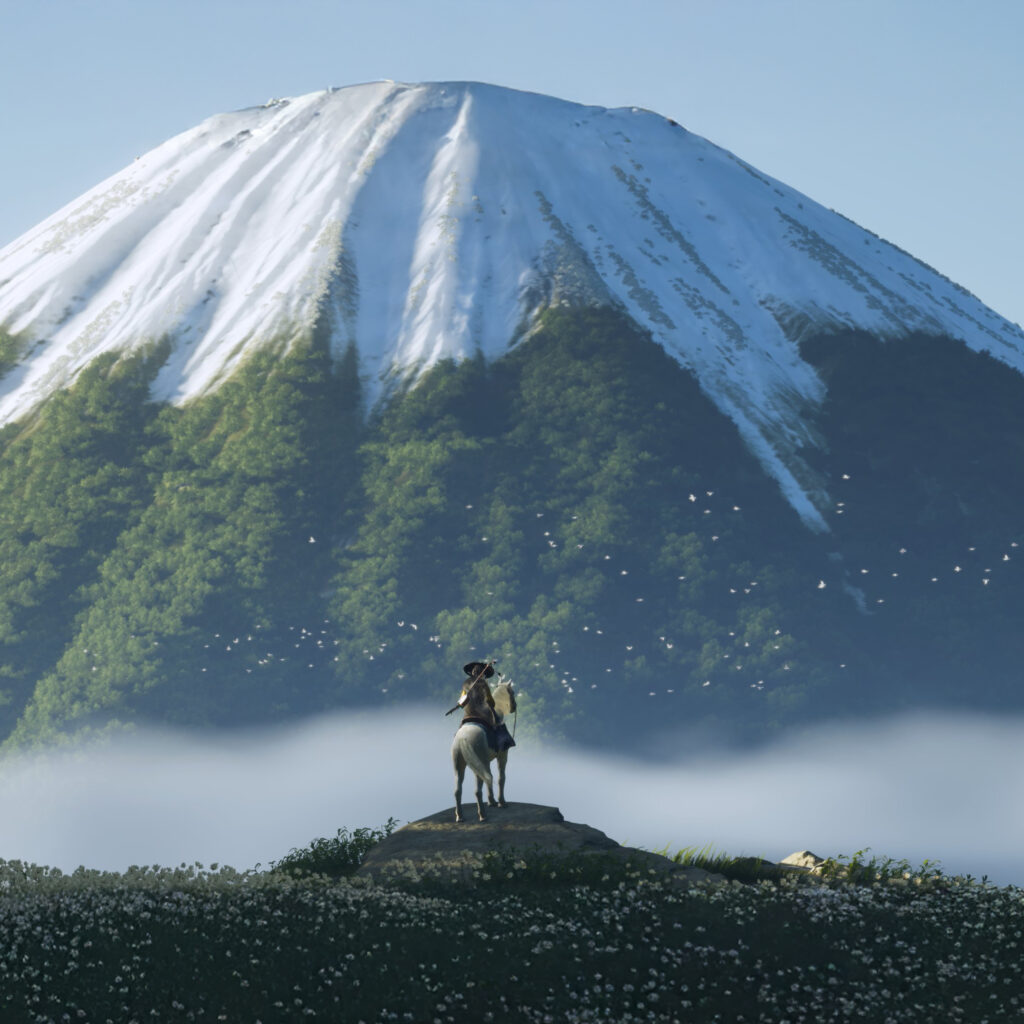
Ghost of Tsushima was a great game that combined stunning visuals with an intriguing story that was mirrored in the mechanics. I was kind of hoping that the developers, Sucker Punch, would leave it at that one game, so that it wouldn’t turn into another series of repetition.
But there came Ghost of Yotei, a spiritual successor to Tsushima. Am I disappointed? Not at all, because I think the developers did what not many dare to do. Rather than just delivering more of the same, they abandoned the story of Tsushima to tell a wholly new one. Granted, the mechanics were altered just slightly, and the gameplay loop was an improved version of the one of Tsushima, yet what I found most interesting, within the same framework, they found another concept to focus on.
What I mean is this: In Tsushima the concept was, that the game mechanics shifted from samurai-fight stances to sneaky and unfair fighting style, while narratively Jin Sakai realizes that he must abandon honour to be able to defeat the mongol army. In Yotei, there is no shift in the mechanics, you have the option to learn unfair fighting moves pretty early in the game. Instead, with holding mechanics and gameplay loop similar, Yotei moves its focus on exploration.
A world wanting to be explored
I often found myself preferring to roam the map to fighting Saito’s soldiers. And I don’t mean that in a negative way, since I think the gameplay loop of clearing camps has been improved, as in there is more variety and less repetitiveness compared to Tsushima. No, I mean, the beautiful and well crafted design of the landscape caught my attention again and again and off I went to explore.
I will refer to the different regions as “levels”. Most of these levels are laid out so that you can see the next point of interest. Especially in the Grasslands (the first “level”) I soon found that it was easy to orient myself. So I challenged myself to simply roam through the lands without using the map. Only in the Ishkari Plane and the Teshio Ridge I didn’t succeed in that, but in the other levels it was easy. In fact, I can’t remember an open world game, where I didn’t check my map to see where I had to go for a certain thing, and then went there and did that thing, and then checked the map again for the location of the next thing and then went there again. That always felt a bit like crossing off a to do list. Here, in Yotei, it felt much more like exploring the land.
Sometimes I would see a point of interest, and knew I wanted to go there, sometimes, I just randomly found a mission, shrine, or other collectible along the way and I changed my route. Or I tried to memorize where I found it and returned to it later. Besides the signaled points of interest and many hidden secrets, there were other ways the game made exploration fun. Sometimes you meet travellers that tell you about a spring, fox den or bamboo cutting place, then you could get off into the direction they pointed at and search for it. There are also the stories about bounties in certain regions. No simple points on a map, but just general directions. And last but not least: The world is simply beautiful and invites exploration.
The emptiness is the point
A fun exploration isn’t a “concept” of the game in itself, it’s just a fun feature. Only if it adds to the narrative themes it really counts as a concept. And I think it does. When I rode through the wide fields of the Yotei grasslands I thought about how in other games I would be bored quickly and would use fast travel, because the emptiness between points of interest is still rather vast. That’s when I realized: The emptiness is the point.
Galloping through the beautiful landscape had something meditative to it. And as weird as it sounds, I don’t think it’s far-fetched. There is literally a mission during a training arc, where the game lets you sit still while it zooms out to show you the gorgeous view of the whole Tokachi Range. The paths to the shrines too, seemed to me as an exercise in meditation. I remember distinctly my climb up the Fall’s Rest Shrine, when the music cut out, and there was just silence. The easy climb mechanics let me fall in trance, until I reached the shrine, in its stunning surroundings and the music softly kicked in again.
My favourite level is Teshio Ridge. Because everything we learned up to this point is turned on its head. While until you enter Teshio Ridge the world was inviting to be explored by its beauty, friendliness and easiness to navigate, now it is hostile. Nothing is as it seems. Shinobi hide underneath the snow and launch a surprise attack when you’re too close. The landscape itself I found difficult to navigate and even the weather is attacking you with snow storms freezing your life total and distorting your view. It is as if you need to learn how to navigate this world first, which you do by deciphering the “secret” signs of the shinobi and by learning how to listen for hidden enemies.
Teshio Ridge has the closest connection to the narrative strand too, because there too nothing is as it seems. Unfortunately the same cannot be said for the Ishkari Plane and the Oshima Coast. In the Grasslands and Tokachi Range the wide emptiness of it all seems to mirror Atsu’s isolation and loneliness. Also, how does the meditation-on-nature-angle of the gameplay fit the main story? After all, the story is about a victim seeking revenge, but everything she encounters on her path pulls her away from her goal (more on that here).
Well, while the main story creates a fault line between being stuck in the past and building a future, the gameplay introduces a third option: living in the moment. However, narratively, that option never really gets explored. So in the end, we are in this weird space, where the game’s conclusion is quite inconclusive because one of its arguments is never really considered. That’s why to me, Ghost of Yotei is a story based on highly exciting concepts but with a flawed execution of tackling them. Which are my favorite kinds of stories to analyse.
Pingback: Ghost of Yotei: Just another Revenge-Story? – Story Structure