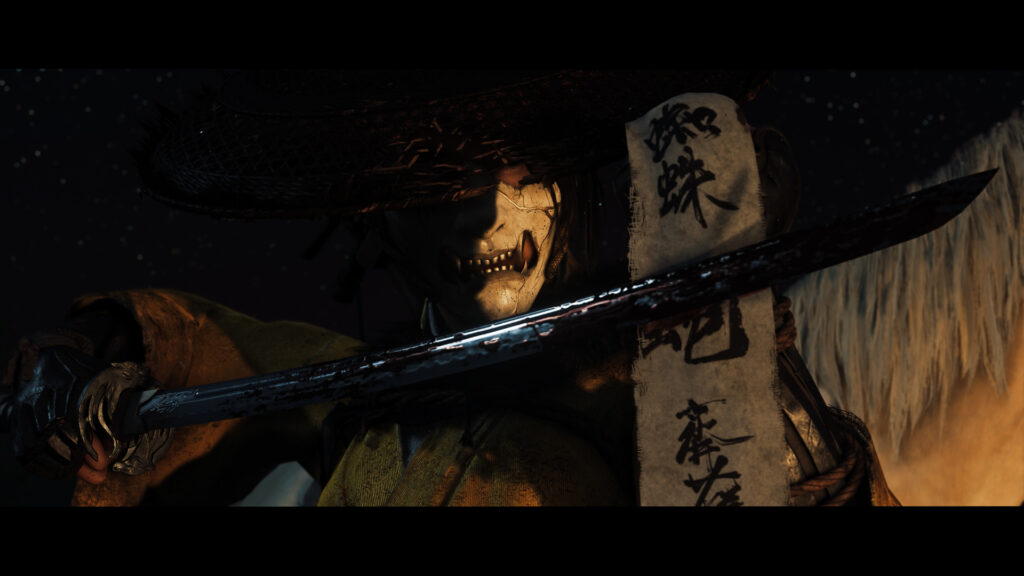
In Japanese mythology an onryo is a ghost that came to be, because a soul couldn’t rest due to its desire for revenge. In Ghost of Yotei, Atsu, the protagonist is called Onryo by some, because she came back to her home to exact revenge for what happened 16 years ago. So is Ghost of Yotei just another Revenge-Story?
In her mind Atsu must kill six people who murdered her parents (and in the beginning of the game, she thinks they murdered her brother too). She was still a child when it happened and was left to die on a burning tree. After managing to escape she was on her own. She had to survive on her own, travelled to the south, where she joined a Samurai-Clan, only to leave it later, fought in a war and grew up. Now after 16 years she comes back to her homeland, ready to exact her revenge. In the meantime the leader of the six, Saito, has built an army and tries to establish a hold on Hokkaido. Yet everything Atsu encounters is trying to keep her from taking revenge. Importantly, those are not obstacles. Those are allies.
Hebi – the Snake
Atsu encounters Hebi in the prologue of the game. He is a leader of a group of thugs terrorising a village. The perfect projection of the evil he sees in the Yotei six. Unfair, heartless and ruthless. But also he is an old drunkard. Seemingly more pathetic than dangerous. Nonetheless she kills him and almost dies herself in the process. Born is the myth of the Onryo. But also foreshadowed is the self-destructive tendencies of our revenge driven protagonist.
Oni – the Demon
The Oni is tasked with renovating an old castle for Saito and for this his hordes are busy blundering the Ishkari Plane for resources. Seemingly another easy target to direct her anger towards. However, on her way to kill the Oni, Atsu encounters two problems. First she meets a samurai who happens to be tasked with freeing the Ishkari Plane from the Oni. As Atsu soon finds out, the samurai is her brother. We learn that he survived the attack on their family too. That in itself is already one less reason to exact revenge. But there is more to it. While Atsu spent the last 16 years alone, preparing herself for her revenge, Juubei, her brother, found a new family in his samurai-clan. With that comes a responsibility that goes beyond his own person.
The estranged siblings try to take on the Oni together, but when it comes to a choice between saving some of Juubei’s fellow clan-members or go after the Oni, they clash in their priorities. Atsu is appalled that her brother had been able to turn his back to the injustice done to their parents. At the same time Juubei is appalled by the hate-driven Onryo his sister had become. He realizes that she merely exists for the sole reason of killing her targets – an onryo. He then proceeds to try to bring back her humanity. He keeps reminding her that there will be a life after revenge. He starts rebuilding their old home, trying to instill in her faith in a future to bring her down from the path of revenge.
He does this not to stand in her way. In fact, he also pursues the goal of killing the Yotei Six and while there is personal emotion attached to it, he does it mainly for different reasons – to restore order in Ezo and to fulfill his duty to his clan. Atsu is not unreceptive to his attempts, but she’s also nowhere near convinced. Which is understandable, since she spent 16 years focused on this one goal. She can’t simply abandon what has essentially become her identity.
There is another albeit smaller “problem” to her revenge. When she meets the Oni first, she is playing a part and thus forced to spend time with him. During that brief encounter, the player and Atsu get to know the Oni as an eloquent warrior with a sense of humour. It almost feels like under other circumstances there could have been some sort of camaraderie blossomed between the two. Yet, it is her obsession with the past that reveals her true identity to him, derailing their plan and bringing her brother and others of his clan in danger.
The Khotan
On her way to her next target after the Oni, she passes a Khotan – a village of the island’s indigenous people, the Ainu. It’s located in a peaceful valley, with close to no presence of Saito’s men. There is no reason for Atsu to spend time here. Yet she does, especially with an elderly woman, who again, repeatedly tries to lead Atsu astray from her revenge-path. The missions we go on with the lady are exercises in peaceful problem solving. Even as they encounter thieves, who have stolen food and clothing from the village, the lady responds with kindness.
I think it is this interlude to the main story that shows how Atsu is not really this onryo she’s made out to be. Her parents have taught her kindness and respect towards other beings. She’s projecting this strong, battle-hardened and gritty presence to the world, and yet again and again her help is not transactional. But the path she ventured on 16 years ago now leaves her no choice than to follow her goal of revenge.
Kitsune – the Fox
In Teshio Ridge, nothing is as it seems (more on that here), and it is in this region, where the elusive Kitsune, Atsu’s next target, and head of Saito’s shinobi is located. In the tavern she finds Oyuki, a shamisen player with a vast knowledge about the area and a grudge against the Kitsune. Together they manage to find Atsu’s target, but during the encounter, she learns that the man under the mask is a different person to the one that wore the same mask in the night she lost her parents. She learns that in fact, that had been Oyuki.
But Oyuki didn’t hide her identity to deceive us and gain an advantage. If that had been the case, it would have been the more satisfying defeating her later on. Instead Atsu – and the player – are forced to forgive. Oyuki regrets her part in the attack on Atsu’s family. We learn that she had helped Atsu to escape during that night and had been punished by Saito later on. Even later she had been ousted as the leader of the shinobi. Before Atsu stood a woman with no power, regret and who could be a possible ally against Saito. 16 years is a long time and a lot can change during that period. Especially people. As unsatisfying as it is for Atsu and the player, we learn this as another lesson, arguing against the case of revenge.
Children – the Dragon and the Spider
As we enter chapter 2 we learn that our brother has a daughter. Atsu has a niece. It again showcases Juubei’s focus on moving on, and it again provides Atsu with a reason to abandon her path of revenge, since she has the chance to get to know a new family. Ironically, her next two targets are Saito’s son. Dragon, the warrior, favoured by his father, and Spider, the drunkard. Before everything goes down, Atsu spends some peaceful times incorporated in the family life of her brother and her niece. She quickly takes a liking to her niece, while the little one in turn starts to look up to her.
The confrontation with the spider happens, after Atsu snuck in to a party of his. Disguised as an entertainer, she is supposed to play a song called “The night of the burning tree”, which is a celebration of the attack on her family. Hatred overtakes her and she kills everyone at the party, except for the Spider. Chapter 2 is called “Onryo”, because this moment is when the ghost of revenge is truly awakened in Atsu. The moment bears parallels to the Battle of Yarikawa in Ghost of Tsushima, where Jin Sakai gets empowered which leads to an important success in an impossible battle. In Yotei too the moment seems empowering at first, since mechanically, it becomes easier to kill your enemies. But soon after it, when Atsu returns and her shocked niece sees her soaked in blood, there is a bitter aftertaste to it.
Atsu didn’t kill the Spider, because their plan is to use him as bait to lure his brother into a trap. However, it goes horribly wrong. The Spider escapes, and Saito attacks the main fortress of Juubei’s clan, where also Juubei’s daughter is staying. Without hesitation, Juubei runs back, to help his clan and especially his daughter. Atsu on the other hand, chooses to use the opportunity to fight the Dragon. She manages to kill him, but the castle is lost and Juubei and Oyuki are captured by Saito.
Atsu’s revenge-driven choice came at a steep cost, and after finding her niece, finally, there is a turning point in her story. After her niece accuses her, that she only brings death, Atsu understands that the path she has chosen can and must be abandoned. It’s not only self-destructive but the desire to avenge those she loved who are dead brings those she loves who are still living in danger. She promises her niece to find Juubei and Oyuki, and freeing them is all that matters to her now.
On her search Atsu finds the Spider, who for his failure has been outcast by his father, grieving the death of his brother at a cemetery. A fight erupts, which Atsu doesn’t actually want to fight anymore. But of course the Spider doesn’t believe her, and first tries to escape. As she still needs the information of the whereabouts of Juubei and Oyuki, she follows him. The chase takes place on a trail to a shrine. Usually in the game those are peaceful, almost meditative. So having a high stakes chase, where he shoots you with a rifle and throws explosives at you feels like disgracing the sanctity of the place. Eventually she defeats the Spider but manages to hold back and not kill him. As a reward of her abandoning her revenge, he brings her to the castle, where her friends are held.
Saito
Atsu manages to save both Juubei and Oyuki and she holds her promise that she doesn’t care that Saito could be in the castle. She was only there to free them. They soon learn however that Saito is at their old home, where Juubei’s daughter was left alone. There Saito agrees to let his hostage go, if Atsu would face him alone.
Throughout the game, Saito has never been the monster he seemed to be during the night of the burning tree. He is shown to be intelligent and wise, even understanding. However, we also learn that the reason he murdered Atsu’s parents was because they had deserted his clan beforehand at a time, where his clan was at its lowest. The night of the burning tree was revenge. We’re told that Saito’s biggest weakness has always been his desire for revenge.
Now the story culminates in a fight between two tragic figures driven by revenge. Even after Atsu has abandoned her path, it is too late to escape tragedy. As Juubei comes in to help her, he gets mortally wounded. As Saito dies, losing all he has previously built up, due to the mistake of exacting revenge in one night, birthing another cycle of revenge, Atsu loses the one family member, she hadn’t lost in the event, that had started her own desire for revenge.
Conclusion
So is Ghost of Yotei just another revenge-story? Well partly yes, but in my opinion it adds an angle I haven’t seen in other similar stories before. Everything Atsu encounters in this story is pulling her away from revenge – the possibility of a future; forgiveness, because people can change; her own kindness within and a newfound family that can replace what she had lost – yet Atsu struggles to abandon her path. None of the kills feel satisfactory and yet she keeps on doing it. It feels as if she is not in charge of her own actions, rather guided by unseen forces. A ghost, damned to perpetuate violence.
Pingback: Ghost of Yotei: Emptiness is the point – and ultimately pointless – Story Structure